|
Rehairing bows is an essential part of a bow maker’s work. Although some regard it as a necessary “evil,” I consider it an important and valuable part of my craft. After all, the quality and characteristics of the hair provide the direct means of producing sound on the instrument. Musicians hold their bows for several hours every day and can clearly feel when their tools are not working as usual. Drawing on many years of experience, I try to understand and resolve the questions that repeatedly arise.
Almost ten years ago, I had the following experience in my workshop. A customer, an excellent violinist, asked me to rehair her old English violin bow. A few days after collecting it, she returned in despair. “The bow no longer sounds right,” she said. Then she added, “Please remove 20 hairs.” Although I found the request completely baffling, I carefully removed the 20 hairs and let her play again. The slight dullness had audibly disappeared: the violin’s sound was radiant, and the unwanted noises were gone. I was visibly astonished by the result, but this small intervention had helped my customer.
Years later, a customer who owned one of my Tourte copies came into the shop. Devastated, he showed me the bow and complained that all the positive qualities that had led him to buy it were gone. It now felt spongy and limp, had lost its liveliness, and sounded dull, with many distracting noises. After careful examination, we established that the only change was an extraordinarily thick new rehair. The original 5.0 g, the ideal amount for this bow, had been replaced at another workshop with an astonishing 7.4 g. A proper rehair restored all the copy’s familiar positive qualities.
What causes such a severe loss of playing and tonal quality? If, for example, we strung a bow with a single hair, that hair would be under extreme tension and might snap immediately. A thousand hairs, by contrast, would have to share the stick’s tensile force. Even if they were exactly the same length, all would be slack and have little tension. At the same time, all the hairs—including those lying on top of others—would try to reach the string at the contact point. The resulting friction noises would directly affect the sound as unwanted background noise.
We are often asked to put more hair on the playing side of the bow. Musicians want a small reserve in case heavier use causes hairs on that side to break sooner, or they hope to give the bow greater lateral stability. Looking more closely at the example above, however, shows that this reduces tension in the hair on the playing side. The player can then more easily press the stick down to the string, rubbing the hair so strongly between wood and string that it breaks much sooner. The same happens when there is too much hair overall. Such experiments also noticeably change the stick’s lateral curvature, with a substantial effect on the bow’s tonal and playing qualities (see the article “The Camber of the Bow”). Because the hairs break more quickly, the system does not remain stable. Every hair that breaks on one side changes the lateral tension on the stick. The bow’s playing and tonal qualities therefore change continually, and much more markedly than with an evenly distributed rehair using a carefully chosen amount of hair.
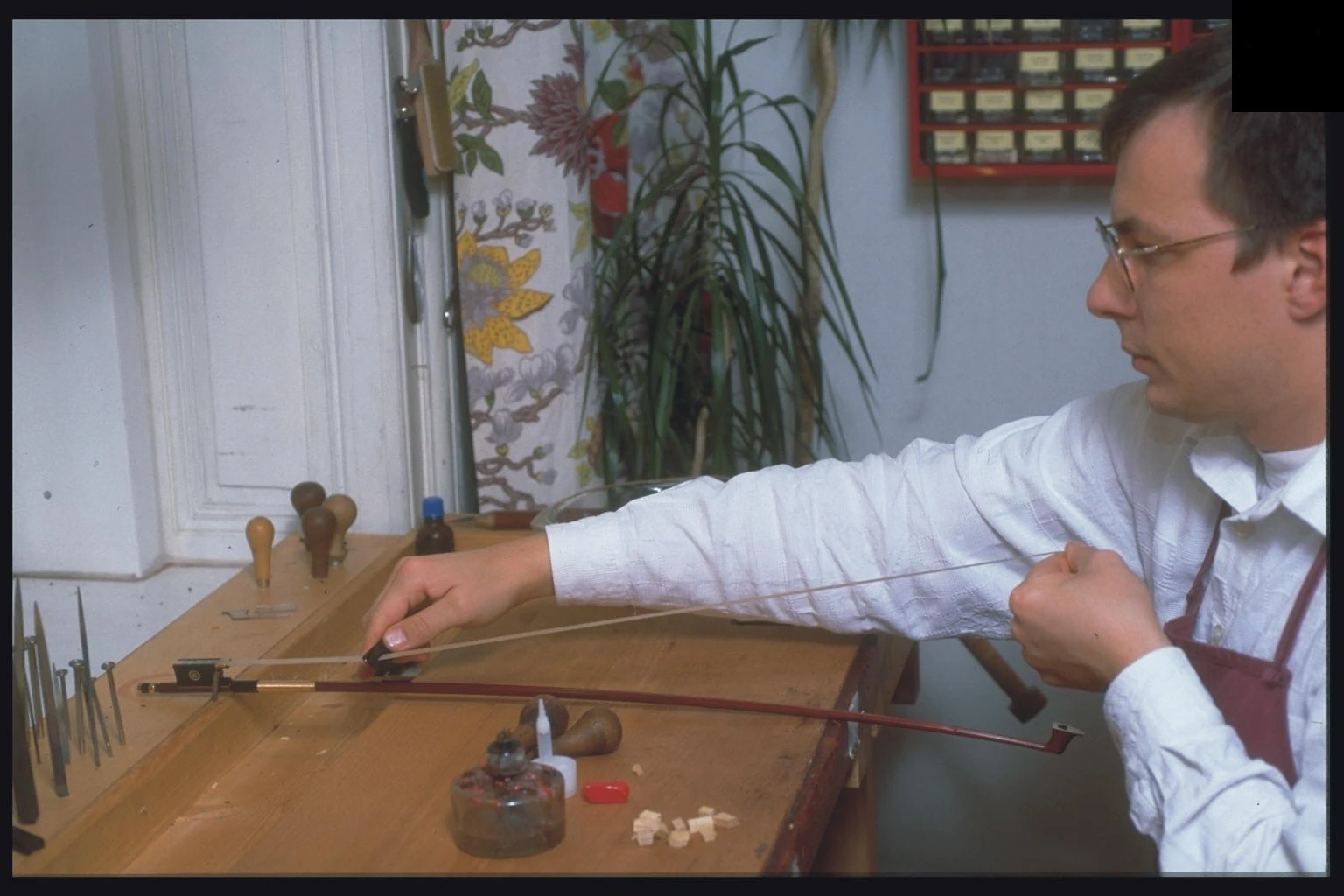
 The maker’s task is therefore to determine the ideal amount of hair from the stick’s stiffness, camber depth, head and frog heights, and type of bow. More than 20 years ago, part of my apprenticeship was preparing hair for the workshop’s master makers. At that time, the hairs were counted individually, with a prescribed number for each type of bow: violin, viola, cello, or double bass. In other workshops, I have seen the amount determined with a premade gauge marked for the different bow types. With a good gauge, this is considerably more accurate than counting. Like human hair, individual horsehairs differ greatly in thickness, structure, surface, durability, and other characteristics. Hair thickness varies noticeably even within a single delivery. Because bow hair is a natural product, bundles with the same number of hairs can differ considerably in thickness; using a gauge reduces this variation. The maker’s task is therefore to determine the ideal amount of hair from the stick’s stiffness, camber depth, head and frog heights, and type of bow. More than 20 years ago, part of my apprenticeship was preparing hair for the workshop’s master makers. At that time, the hairs were counted individually, with a prescribed number for each type of bow: violin, viola, cello, or double bass. In other workshops, I have seen the amount determined with a premade gauge marked for the different bow types. With a good gauge, this is considerably more accurate than counting. Like human hair, individual horsehairs differ greatly in thickness, structure, surface, durability, and other characteristics. Hair thickness varies noticeably even within a single delivery. Because bow hair is a natural product, bundles with the same number of hairs can differ considerably in thickness; using a gauge reduces this variation.
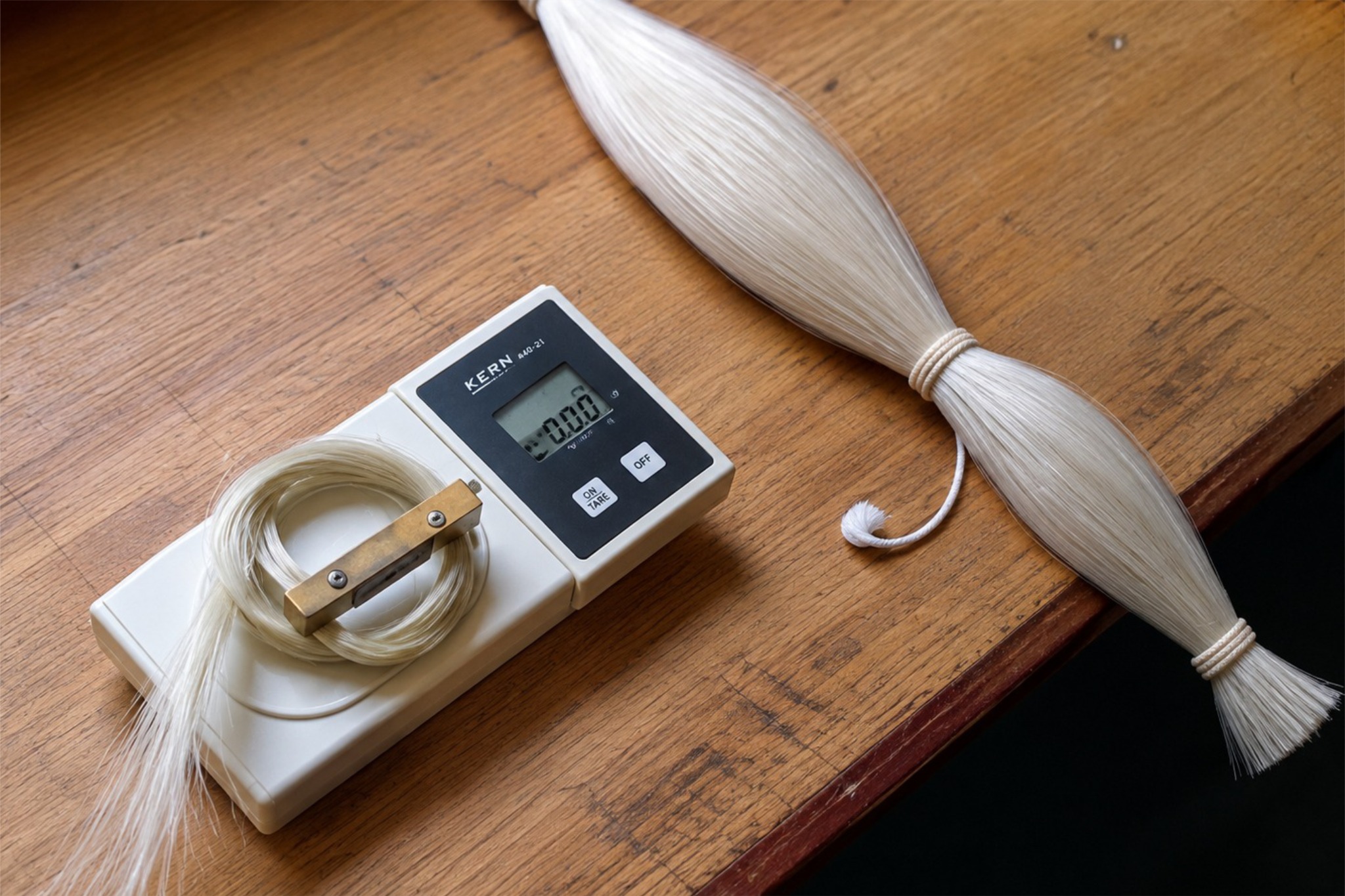
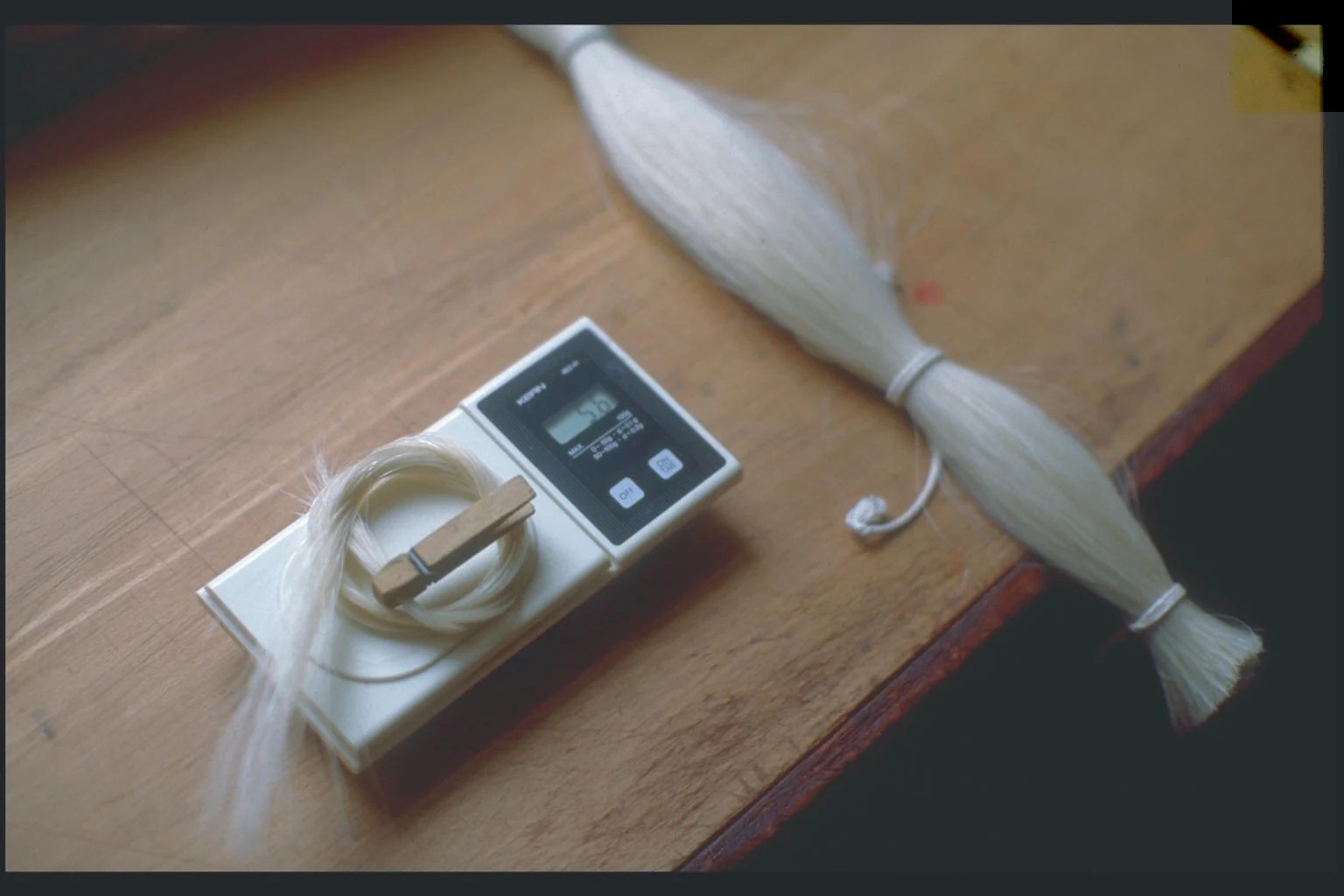
The most accurate method, however, is weighing the hair. This first allows the greatest attention to be given to removing unsuitable hairs: those with uneven thickness, knots, growth irregularities, discoloration, or an inflexible, “dry” character. Around 30–60% of the starting material is discarded in this way. This time-consuming work is necessary to provide the musician with a durable, high-quality rehair. Counting directs attention primarily to quantity rather than quality. With weighing, every hair can be inspected; the prepared bundle is weighed periodically, and hair is added or removed as needed.
In my workshop, we use high-quality hair with an original length of more than 100 cm. It comes exclusively from stallions because their tail hair is much less affected by uric acid than mares’ hair and is therefore more durable. Naturally, the hairs become progressively thinner toward the lower end of the tail. This section is cut off. Using exceptionally long hair allows me to select only the best sections of this fine material for the finished rehair.
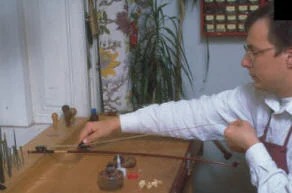 The bow maker’s ability to assess hair quality rests mainly on evaluating its physical properties. How does a hair behave under load? A single normal hair can support a weight of about 600–800 dg without breaking. When high-quality hair is stretched, it yields and then contracts again. The bow maker’s experience is essential in evaluating the result. Of course, hairs overstressed in this way can no longer be used, which exposes a fundamental limitation. Only a few samples can be taken from each bundle, usually supplied in quantities of about 0.5–1.0 kg. This cannot guarantee uniform quality throughout the delivery, although the tests are certainly informative. The bow maker’s ability to assess hair quality rests mainly on evaluating its physical properties. How does a hair behave under load? A single normal hair can support a weight of about 600–800 dg without breaking. When high-quality hair is stretched, it yields and then contracts again. The bow maker’s experience is essential in evaluating the result. Of course, hairs overstressed in this way can no longer be used, which exposes a fundamental limitation. Only a few samples can be taken from each bundle, usually supplied in quantities of about 0.5–1.0 kg. This cannot guarantee uniform quality throughout the delivery, although the tests are certainly informative.
We have few ways to assess a rehair’s grip and longevity in advance. Despite all our care, we depend on customers’ feedback. Assessing longevity is especially difficult because we use approximately one delivery of hair per month. By the time negative feedback arrives, that delivery may already have been used up, and the new bundle may not have the same problem. Nevertheless, all feedback—including positive feedback, which is always welcome—is important to maintaining the quality of our rehairs.
You can read about how the hair is secured in the bow in the “Hairing the Bow” section of the “Bow Making” page.
Thomas M. Gerbeth |