|
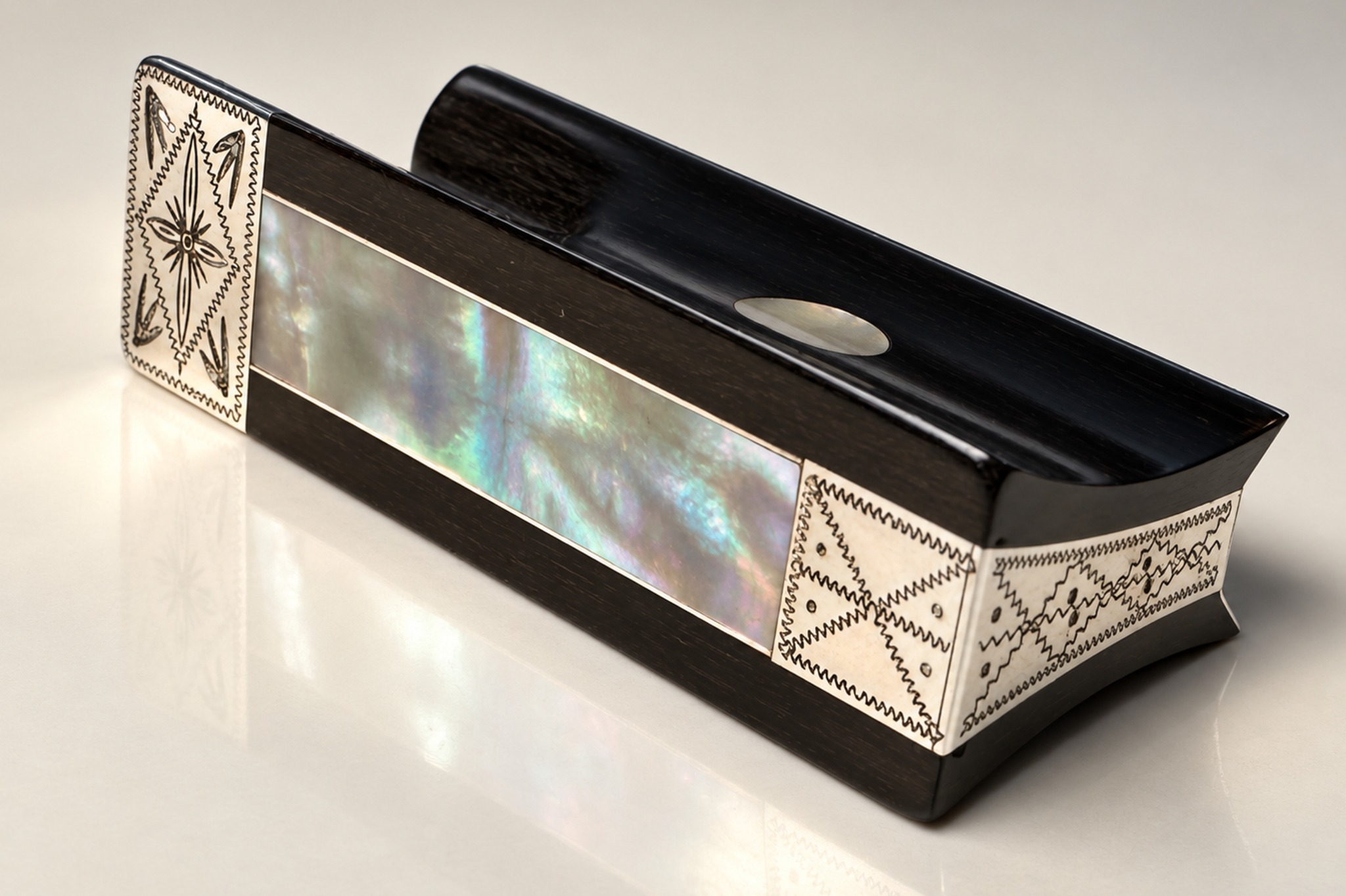
The bow did not always have a richly decorated frog. In its earliest days, the hair was tied to the stick at both the tip and the handle end. Since the stick was convex—curved outward—its shape more closely resembled the weapon with which it shares its name. The playable length of hair was much shorter than it is today. Even in the early seventeenth century, the stick was still convex or almost straight. At the lower end, a removable wedge held the hair away from the stick. This removable frog gives the clip-in frog bow its name. On these bows, too, there was still no mechanism for adjusting hair tension: the hair was secured by wedges in the stick at both ends, and the clipped-in frog occupied a fixed position. Since horsehair changes length with humidity and temperature, the hair was presumably sometimes tighter and sometimes looser. With the viol, the bow is held underhand, allowing the middle and ring fingers to pull the hair away from the stick. This kind of manual tensioning is not possible with the overhand hold of the violin bow.
It is now thought that players were already looking for ways to modify violin bow hair tension at that time, inserting small additional wedges or pieces of gut string between the hair and the frog when the hair became too slack.
Since the hair stretched out too quickly under constant tension, the frog could be removed from the stick after playing, allowing the hair to recover. The next time the bow was used, the frog was reinserted into the groove in the stick, bringing the hair back under tension.
Where Does Its Name Come From?
Unfortunately, the exact origin of the German term “Frosch”—called “hausse” in French—for this removable wooden wedge is unclear. There are, however, several theories of varying plausibility. Some suggest that the name may derive from its shape, which on certain older bows does resemble a sitting frog. Looking at the etymological roots of “Frosch,” one finds the form “froska”: to hop. Did the wedge spring away from the musician like a hopping frog when it was removed?
Another possibility is a misunderstanding between languages: the French “hausse” (pronounced “os”) can also mean a support or base in German. Over time, this “hausse” may have become a “Frosch.” In carpentry, “Frosch” is also used for projections or supports between beams, and the projecting ends of barrel staves are likewise called “Frosch.”
The question probably cannot be answered with certainty. Then as now, however, the frog’s function is to keep the hair away from the stick at the lower end of the bow.
Anke Gerbeth |