|
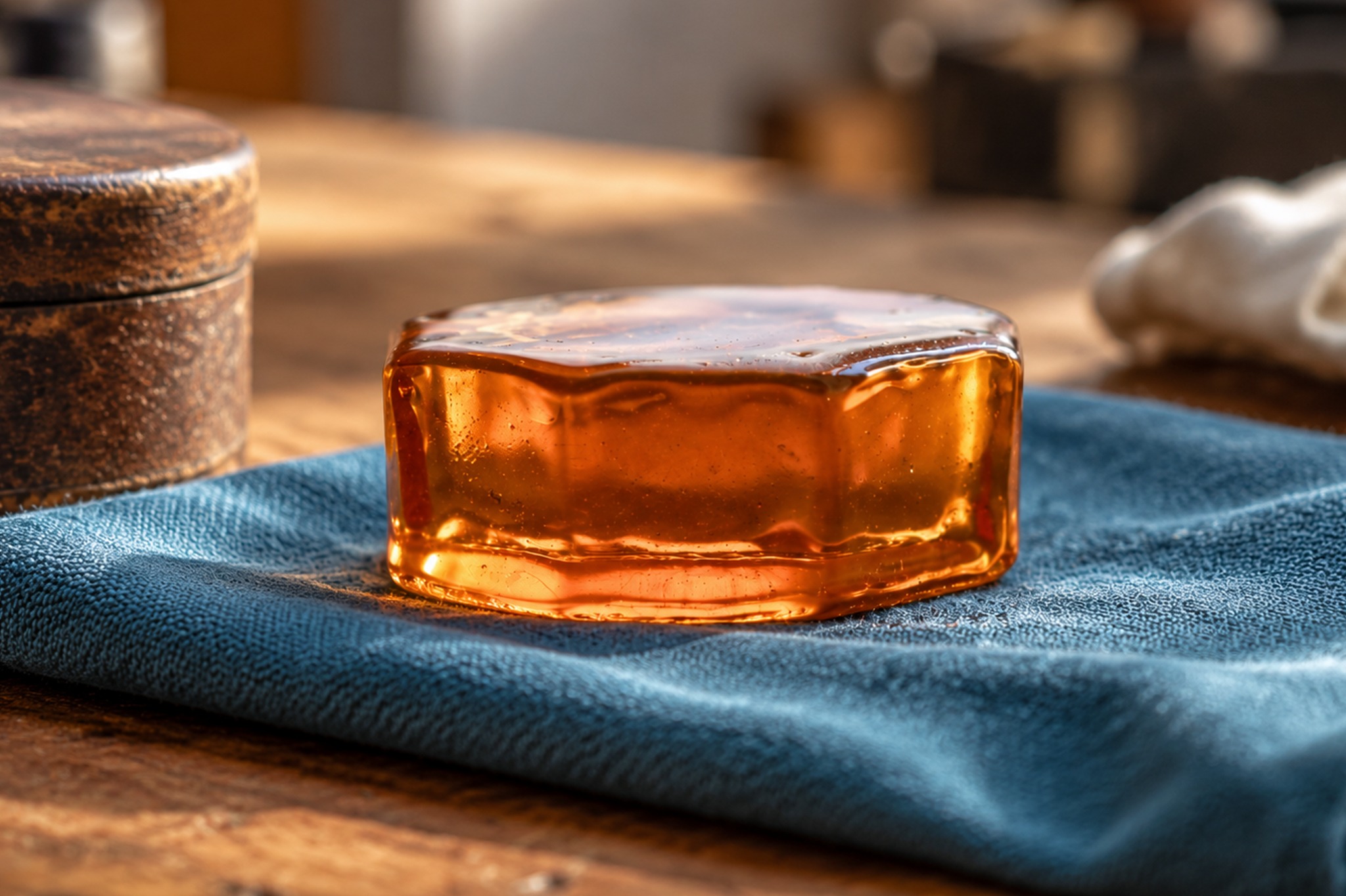
Often neglected and sometimes elevated to a philosophy in its own right, this material makes audible sound possible through contact between string and bow hair. It holds many secrets waiting to be explored.
Its name, colophony, derives from the ancient city of Colophon in Asia Minor, where high-quality rosin was produced in antiquity. Under reformed German spelling, the German word would be written “Kolofonium,” but the traditional spelling is retained here for aesthetic reasons. Rosin is obtained from the residue left after turpentine oil is distilled from conifer resins, including those of Mediterranean pines, other pines, spruces, firs, and larches. It consists mainly of resin acids, including abietic acid, and is used in remedies, incense, lacquers, varnishes, and bow rosin.
Inexpensive rosin made from by-products of paper manufacturing also enables sound production, but the difference from handmade products is clearly audible.
In the early 20th century, a distinction was made between yellowish French or American rosin and brownish German rosin. Both types are transparent or translucent, odorless when solid or faintly reminiscent of turpentine, and soluble in alcohol, acetone, chloroform, carbon disulfide, and turpentine oil.
Unfortunately, we do not know the exact recipes for the various rosins on the market, since manufacturers guard them as trade secrets.
The products can nevertheless be divided roughly into two groups. Their difference may appear small, but it has major consequences: one group is based on larch resin, the other on resins from other conifers such as Mediterranean pines, other pines, spruces, or firs. Both groups include excellent products that can satisfy musicians and show their full quality when used alone. However, larch-based rosin should never be mixed with the other types. If it is, the two react with one another, and the mixture no longer grips the string or moves it effectively from its resting position. The hair feels as though it has been coated with soap.
Cleaning the hair with soap and water, or even alcohol, does not help. Water does not properly remove the rosin, while alcohol softens it, allowing it to combine with other dirt and make the hairs stick together. Alcohol also requires caution because it dissolves the stick’s varnish or polish and can cause serious damage. Unfortunately, the only way to make the bow usable again is to replace the hair. The same applies to any other contamination of the hair.
The different properties of these rosins may arise from differences between the trees and their resins. The European larch (Larix decidua) is, as is well known, the only native conifer to shed its needles in fall and grow new ones in spring. Exactly which chemical processes cause the “saponification” described above would need to be investigated by a specialist.
People repeatedly ask which rosin is best, but there is no simple answer. A musician’s choice depends not only on the instrument, but also on their tonal ideal and playing style. Different cooking temperatures produce different degrees of hardness, suited to instruments from violin to double bass. Manufacturing methods and additives determine the rosin’s melting point or range, which in turn affects tonal qualities.
According to a study by Anders Askenfelt of Sweden, friction during sound production heats the rosin on the string at a microscopic level to 70–90 °C, causing it to melt. The bow hair briefly loses contact with the string before gripping it at another “cold” point and pulling it again. Askenfelt illustrates this process with highly sensitive thermal cameras that clearly distinguish the temperatures of the violin, strings, hands, bow hair, contact points, and other elements.
The frictional energy needed to melt the rosin varies with the surrounding temperature. This is why an instrument plays differently in a cold church and a hot concert hall. Some musicians try to compensate by using rosins from the same group or manufacturer with different melting points—for example, a soft rosin in church and a hard one in the concert hall.
High-quality rosin is made to produce little dust during application and playing. This matters because rosin dust can irritate the nasal mucous membranes. Some people develop allergic reactions, including swollen mucous membranes, sneezing, burning in the mouth, nose, and eyes, and even blistering of the facial skin. Fortunately, such allergies are rare. An allergy to a larch-based rosin, for example, does not necessarily mean that the other group will cause the same reaction.
Anke Gerbeth |