|
To explore the origins of the bow, we must first consider the musical bow, which may have developed from the hunting bow. The musical bow, the simplest stringed instrument in the zither family, consists of a flexible curved stick holding a taut cord or string. Still found among the peoples of southern Africa, South America, and Oceania, it measures between 80 and 120 cm in length; in parts of East Africa, it can be up to 3 m long. The string is struck with a small stick or set in motion by rubbing it with a roughened rod. Less commonly, it is plucked. Simple sequences of notes can be produced by changing the bow’s curvature, thereby altering string tension and pitch; by touching the string at its natural vibration nodes to produce harmonics; or by using tuning loops that divide the string and vary its pitch.
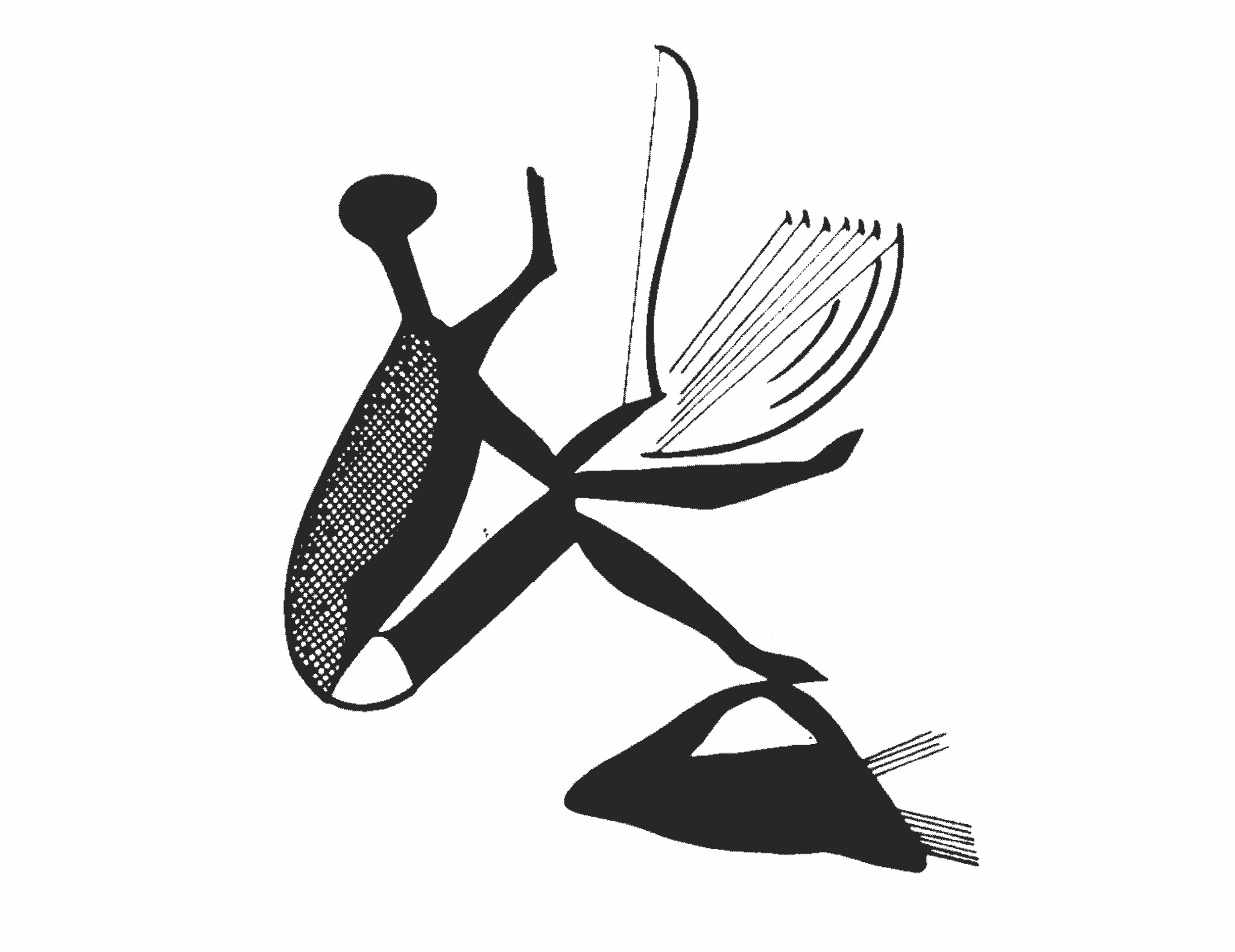
What may be the earliest evidence of a musical bow appears in a Paleolithic cave painting dating from about 15,000–10,000 BCE. These paintings in the Trois Frères caves in southern France depict dancing, masked sorcerers dressed in animal skins. One figure, disguised as a bison, holds a bow-like object whose meaning remains disputed among specialists. Since the only instruments known from Paleolithic finds so far are pipes, experts are uncertain whether the object in Fig. 1 represents an end-blown flute or a musical bow. This does not rule out the use of musical bows whose materials did not survive. Hunting bows are known to have been used in different parts of the world during this period. In his handbook of musical instruments, A. Buchner takes the argument further, suggesting that “the prehistoric hunter noticed the sounds produced by the bowstring when a shot was released” and probably began “to pluck it without intending to shoot, which may have given him pleasure. In time, he realized that bows of different lengths and tensions produced notes of different pitches. When he held the end of the bow in his mouth, tightened the bowstring, and plucked it to judge from its pitch the force with which it would launch an arrow, he must have noticed that the mouth cavity amplified the sound of the string. In this way, he probably discovered, unknowingly, both a resonator and a musical instrument. The magician depicted in the Trois Frères cave holds the upper end of the bow in his mouth, presses its lower end toward himself with his left hand, and plucks the bowstring with his right.”
The quality of the cave drawing makes this theory somewhat difficult to follow. Identifying a right or left hand performing the actions described would be highly speculative. The figure could equally well be a hunter with a bow and arrow.
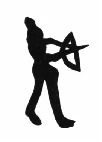 A cave painting in northwestern Bulgaria (Fig. 2) also appears relevant to the early history of the bow. In his handbook of musical instruments, Buchner writes: A cave painting in northwestern Bulgaria (Fig. 2) also appears relevant to the early history of the bow. In his handbook of musical instruments, Buchner writes:
“This cave painting depicts a musical bow played with a bow. It forms part of the rock paintings in the Rabish Cave near the town of Belogradchik, and the composition has two levels. The upper level shows a group of dancing women and naked men, evidently painted with dark, ocher-colored kaolin applied by finger. The cave’s damp microclimate eroded and destroyed the rock surface, but the pigment acted as a protective insulating layer and resisted erosion. The pictures thus became a sculptural relief: nature itself preserved the original painting and demonstrated its authenticity. The central figures in the lower part of the painting are two musicians. One holds a bow upright in his left hand, facing toward him, and appears to sound its string with a bow or rubbing stick in his right. The second figure carries a double-headed drum on his chest and strikes it with both hands. Although this find has not yet been studied in detail or dated, its enormous significance for the study of musical instruments already merits consideration.”
If closer examination confirms the painting’s authenticity and supports the interpretation of the object as a bow, this would be one of the earliest depictions of a bow, even though the rock painting has not yet been dated precisely. It could, however, also be an accidentally reversed depiction of a hunting bow and arrow. Further interpretation based on the sketches reproduced by Buchner would be too speculative.
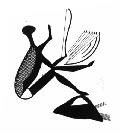 Buchner sees evidence of the musical bow’s presence in southern Africa in a rock painting in Cape Town, South Africa (Fig. 3). A San man holds a bow in his right hand whose curvature differs from that of the other seven bows shown. A quiver of arrows lies at his feet. The figure could indeed be engaged in a musical activity. But can this be established as conclusively as Buchner suggests? Does he go too far when he writes, “A Bushman holds the bow in his right hand and touches the strings of seven other bows with it,” and concludes that this represents a more advanced stage “in which seven bows form a single instrument, while the bow in the musician’s right hand has already taken on the function of the modern bow”? Could the scene instead depict a maker of hunting bows, with several finished bows laid out before him, who is tensioning the string of a new one? Here, too, the interpretation of the source as evidence of musical instruments is not conclusive. Buchner sees evidence of the musical bow’s presence in southern Africa in a rock painting in Cape Town, South Africa (Fig. 3). A San man holds a bow in his right hand whose curvature differs from that of the other seven bows shown. A quiver of arrows lies at his feet. The figure could indeed be engaged in a musical activity. But can this be established as conclusively as Buchner suggests? Does he go too far when he writes, “A Bushman holds the bow in his right hand and touches the strings of seven other bows with it,” and concludes that this represents a more advanced stage “in which seven bows form a single instrument, while the bow in the musician’s right hand has already taken on the function of the modern bow”? Could the scene instead depict a maker of hunting bows, with several finished bows laid out before him, who is tensioning the string of a new one? Here, too, the interpretation of the source as evidence of musical instruments is not conclusive.
There is no evidence of bowed instruments in the ancient civilizations of Mesopotamia (3000 BCE), Egypt (early period, 2900–2160 BCE; late period, 712–332 BCE), Judea (around 1000 BCE), Greece, or Etruscan Italy. Idiophones, aerophones, and chordophones were used, but the latter were plucked by hand or sounded with plectrums made of wood, bone, or other materials.
The literature occasionally refers to the use of bowed instruments at the time the Bible was written. Under the entry “Geige,” for example, the Brockhaus/Riemann music dictionary notes: “…for example, Luther translates 1 Samuel 8:6 as fiddeln in 1523 and geygen in 1534.” This would seem an important indication of the very early existence of bowed instruments. Closer examination of the original Hebrew text, however, reveals a translation error in Luther’s version: the passage cannot refer to a bowed instrument. More recent translations instead speak of “hand drums … and cymbals,” while Die gute Nachricht refers to the “sound of lutes and tambourines” in the same passage. This source therefore cannot serve as evidence for the bow’s development, although it does indicate the instrument’s—or instrument family’s—standing around 1530.
One very early bowed instrument still found among Buddhist monks in Asia is the ravanastron. According to legend, it was invented by Ravana, king of Ceylon, who is said to have ruled around 5000 BCE. Nothing is known about the truth of this story. It is recorded, however, that the instrument was played with horsehair coated in resin.
The first firm indications of bowed instruments in Central Asia appear in writings by prominent scholars such as al-Farabi (…950), Ibn Sina (…1037), and Ibn Saila (…1048). These scholars came from the regions of Sogdiana and Khwarazm, east of the Amu Darya (Oxus). Their classifications of musical instruments mention chordophones whose strings are made to sound by rubbing them with other strings or with some kind of string-like material. On the basis of these writings, Bachmann makes a convincing case for locating the bow’s origins in Central Asia.
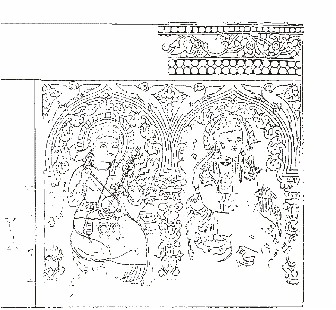 The wall painting in Fig. 4, dating from the 9th or 10th century, clearly shows a person playing a bowed instrument. It was discovered during excavations of a palace in Tajikistan. Since the palace was destroyed in the 11th century and the painting was whitewashed over at the end of the 10th, the image must date from the 10th century at the latest. The wall painting in Fig. 4, dating from the 9th or 10th century, clearly shows a person playing a bowed instrument. It was discovered during excavations of a palace in Tajikistan. Since the palace was destroyed in the 11th century and the painting was whitewashed over at the end of the 10th, the image must date from the 10th century at the latest.
The bow’s emergence in Asia is further supported by Liu Jingshu and Martin Gimm’s article on China in Die Musik in Geschichte und Gegenwart. In the chapter covering approximately 581–960 CE, the authors refer to tomb reliefs of Wu Jian (846–918) from the Five Dynasties period (907–960) and to his contemporary Duan Anjie, writing in the late 9th century. Among a variety of some 300 instrument types, the latter describes “two bowed instruments that never became particularly popular and were probably ultimately of Iranian origin: xiqin, a two-stringed lute played with a bamboo bow between the strings, and yazheng, a seven-stringed bowed zither rubbed between the strings with a bamboo bow.” The description of the xiqin could also fit the two-stringed Chinese fiddle e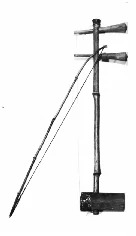 rhu (see Fig. 5), which is still played today. Its hardwood body often has a hexagonal or octagonal cross section, and its soundboard is covered with snakeskin. Two strings tuned a fifth apart are attached to a neck made from a bamboo rod. As with the xiqin, the bamboo bow passes between the strings. It has not been possible to establish whether the erhu, which is not mentioned in the article cited above, is another name for the xiqin or a later stage in its development. The available literature on Persian music and instruments of this period does not mention bowed instruments. rhu (see Fig. 5), which is still played today. Its hardwood body often has a hexagonal or octagonal cross section, and its soundboard is covered with snakeskin. Two strings tuned a fifth apart are attached to a neck made from a bamboo rod. As with the xiqin, the bamboo bow passes between the strings. It has not been possible to establish whether the erhu, which is not mentioned in the article cited above, is another name for the xiqin or a later stage in its development. The available literature on Persian music and instruments of this period does not mention bowed instruments.
Asian national and folk bowed instruments include the Indian sarangi, the Pakistani sarinda, the Mongolian morin khuur, and the Cambodian tro Khmer. In Javanese gamelan, the rabab, a spike fiddle of Persian-Arabic origin, has a distinctive role. The end-blown suling flute and the rabab play independent countermelodies against the principal melody. Simple bowed instruments are also found among African peoples. The literature, however, provides no information about the age, origins, or routes of transmission of these instruments. Unfortunately, nothing is known here about bow forms or the materials used either.
Image credits:
Fig. 1: Buchner, Alexander: Handbuch der Musikinstrumente. Hanau/M., 2nd ed., 1985, p. 20.
Fig. 2: Ibid., p. 27.
Fig. 3: Ibid., p. 26.
Fig. 4: Bachmann, Werner: “Bogen.” In: Finscher, Ludwig (ed.): Die Musik in Geschichte und Gegenwart. Vol. 1. Kassel, 2nd ed., 1994, col. 1636.
Fig. 5: Buchner, Alexander: Handbuch der Musikinstrumente. Hanau/M., 2nd ed., 1985, p. 224.
Anke Gerbeth |