|
Few musicians, whether professionals or amateurs, have the opportunity to look over a Bogenmachermeister’s shoulder as a bow—perhaps even their own—is being made. Many makers produce bows in larger batches, allowing customers to select a suitable bow from a wider choice, or supply violin makers and dealers instead. Direct contact between bow maker and musician is therefore rare and is sometimes not sought.
As a result, few players know how their bow was made or how it acquired its curved shape. The effects of different cambers—the technical term for the stick’s curvature—on playing behavior and tonal qualities are largely unknown.
Like all woods, the bow-making woods pernambuco and massaranduba, also known as brazilwood, consist largely of lignin. Lignin is the wood’s structural substance, deposited within the cellulose and providing additional stiffness to the fibers. Heat makes these fibers flexible. Only in this heated state, at temperatures of 120–140 °C, can external force give them a new shape. Once cooled, the deformation produced by this method is lasting and stable. Interestingly, however often a bow stick is properly recambered, the material’s strength and structure remain unaffected.
 Every wooden bow begins with a blank roughly sawn from a board along the grain. This matters because the fibers offer enormous resistance along their length during bending. Breaking them longitudinally while hot is almost impossible. By contrast, the forces between individual fibers are relatively small. Irregular growth and sloping grain therefore create a substantial risk of breakage, both during making and in the finished bow. Every wooden bow begins with a blank roughly sawn from a board along the grain. This matters because the fibers offer enormous resistance along their length during bending. Breaking them longitudinally while hot is almost impossible. By contrast, the forces between individual fibers are relatively small. Irregular growth and sloping grain therefore create a substantial risk of breakage, both during making and in the finished bow.
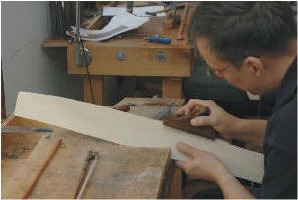
The stick is then rough-planed to a four-sided cross section, remaining 1 mm thicker than the finished bow at every point. With well-selected wood, the stick is almost straight at this stage.
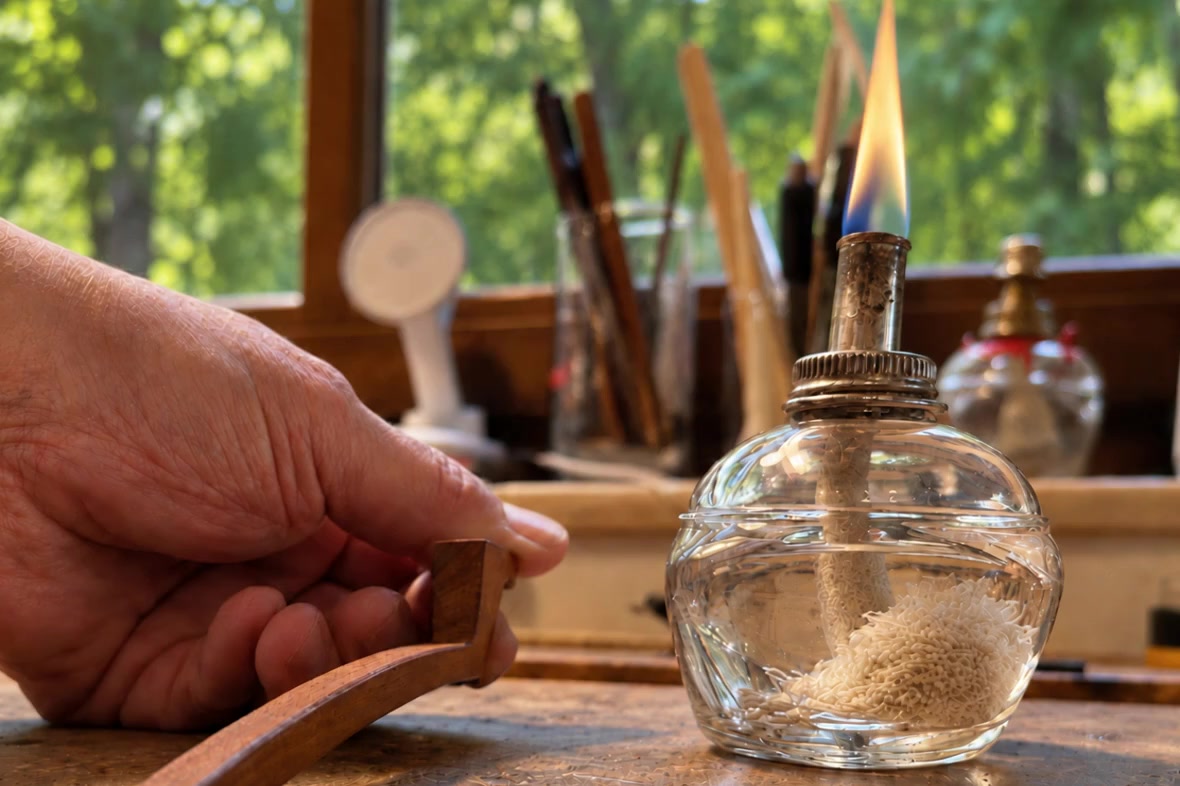
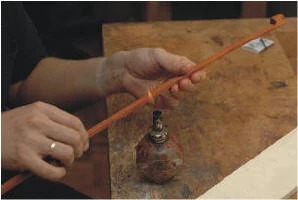
The workpiece is carefully heated in sections over an open flame, usually from an alcohol lamp or, in some workshops, a gas flame. It is held briefly in the flame and then exposed to room temperature again for a few seconds. During this interval, heat travels from the outer layers inward, creating an even temperature throughout the cross section. This is important for preventing later stresses and changes in camber. Continuous heating, on the other hand, would damage—and actually burn—the outer surface, destroying the material’s structure.
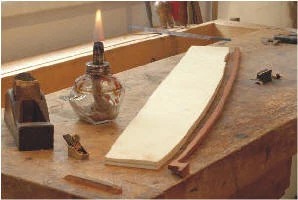
 Once the ideal bending temperature is reached, the material can be shaped over the edge of the workbench or the maker’s knee. When the treated section cools, it retains its new shape. The next section can then be treated in the same way, gradually giving the entire stick an even camber. The curve is repeatedly checked against the intended profile. At this stage, a template with a matching concave cutout is used. Later, once the frog has been fitted, the bow is also checked under tension. Once the ideal bending temperature is reached, the material can be shaped over the edge of the workbench or the maker’s knee. When the treated section cools, it retains its new shape. The next section can then be treated in the same way, gradually giving the entire stick an even camber. The curve is repeatedly checked against the intended profile. At this stage, a template with a matching concave cutout is used. Later, once the frog has been fitted, the bow is also checked under tension.
Almost every stage of making the stick includes steps to refine the camber. Plane and flame take turns in shaping it.
Final adjustments are made to the completed bow. Once the hair has been rosined, the maker can assess for the first time whether the bow has the intended playing characteristics and tonal qualities. Further changes to the camber can then tailor the bow to the musician and instrument. This is comparable to moving the soundpost or changing the strings or bridge of a newly acquired instrument. Only when musician, instrument, and bow work together do the subtleties become apparent, allowing targeted adjustments to the camber to improve the result.
 Barely visible irregularities can sometimes affect playing and tonal qualities more strongly than curves that depart considerably from the “norm.” A bow may also behave exceptionally steadily for one musician while proving uncontrollable for another. This instability—the stick developing audible and visible oscillations without the player’s intervention—produces the so-called “caterwauling” sound, particularly when children play with low-quality bows. Barely visible irregularities can sometimes affect playing and tonal qualities more strongly than curves that depart considerably from the “norm.” A bow may also behave exceptionally steadily for one musician while proving uncontrollable for another. This instability—the stick developing audible and visible oscillations without the player’s intervention—produces the so-called “caterwauling” sound, particularly when children play with low-quality bows.
The overall depth of the camber also affects how sound is produced. If we assume that the ideal gap between hair and stick is about 8 mm, a more deeply cambered stick will tension the hair more firmly in this playing position than a shallower one. More tightly tensioned hair meets the string more firmly and produces sound in a more “aggressive” way than looser hair, which goes more “into the string.” At the same time, bouncing behavior, speed of reaction, response, and even the perceived balance of the bow can be substantially affected.
Even an expert reaches the limits of what is possible, however, when the material and the stick’s shaping are not well matched.
Anke Gerbeth
|