|
The Bow from 1770 to 1800
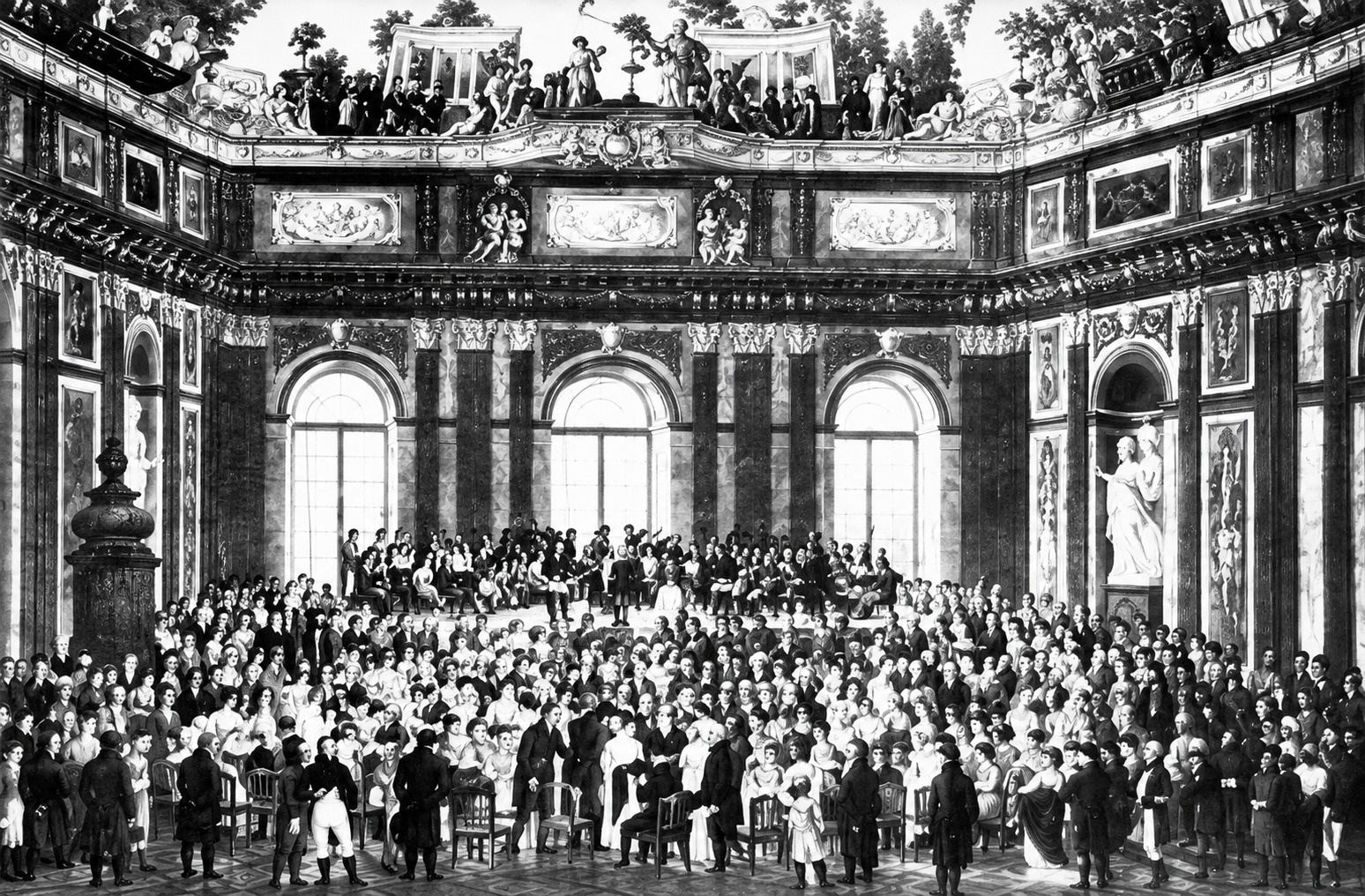
This period was marked by major political changes that culminated in the French Revolution of 1789. These changes also had a profound influence on musical life. Until then, art music had been performed almost exclusively at aristocratic courts, where musicians depended on their patrons and music was accessible to only a small audience. Concerts were now increasingly organized by middle-class concert societies. As these audiences grew, so did the rooms in which music was performed. These large new concert halls called for a sound that could fill them. Beginning in Paris, violin makers such as Pique and Lupot modified neck angles, neck lengths, bridges, and bass bars on both new instruments and outstanding old ones to meet the new demands. Developments in the bow went hand in hand with these changes.
Compared with the Baroque bow, the stick became somewhat longer overall. Various taller, stronger, and therefore heavier frog designs were tried, and the head also became taller and more substantial. The ribbon of hair became somewhat wider as more hairs were used, now measuring about 7–8 mm.
This gave rise to the so-called Cramer bow, which was—and still is—often described as a transitional model. The earliest document referring to such a bow is a Paris estate inventory from 1787, which mentions “quatorse archets de violon à la Cramer.” A hammer-head model appeared in England shortly afterward.
Unfortunately, it is not known how far the German violinist Wilhelm Cramer (1743 or 1745–1799) was responsible for the bow’s new shape and its associated playing qualities. Nor do we know whether Cramer acquired the new model in France and spread it throughout Europe from there, or whether he had already brought it with him from Germany. In his “The History of Violin Playing from Its Origins to 1761,” David D. Boyden describes Cramer as a violinist who evidently possessed extraordinary abilities and, as such, undoubtedly influenced English bow makers.
This bow model is distinguished by its rather tall, angular head, whose shape also gave it the name hammer-head bow. The large, heavy head moves the balance point closer to the middle of the bow. By modern standards, Cramer-model bows are very tip-heavy. The tall head, however, ensures considerable clearance between the hair and the stick, making a concave camber possible. The hair can now be tensioned more firmly, since even pressure on the hair cannot cause the ends of the stick to move inward. The stick can yield downward only in the middle. The more the hair is tensioned with the movable screw frog, the more powerful the bow feels and the louder the sound it can produce. Bows of this type are found throughout Europe between 1770 and 1800, with the earliest documented examples in France. The model enjoyed its greatest popularity between 1772 and 1792. Many bow makers responded to the strong demand. In France, for example, L. Tourte, Lafleur, and members of the Meauchand family made such bows. In England, they were made by Edward and John Dodd, among others, and by workers at the firms of Forster and Norris & Barnes. This bow type was also very popular in Germany.
 These bows were made from both snakewood and pernambuco. The frog could be richly decorated in the Baroque manner or have a simple shape. The plain, straight-lined form later developed into the frog of the modern bow. These bows were made from both snakewood and pernambuco. The frog could be richly decorated in the Baroque manner or have a simple shape. The plain, straight-lined form later developed into the frog of the modern bow.
The way the frog sat on the stick in the early days of the screw mechanism is interesting. An ivory plate, tapering to a point at the front, is inlaid into the underside of the stick. This plate covers a V-shaped recess in the wood, also found on clip-in frog bows. On those bows, it formed the groove that held the frog in position. Musicians may have had their clip-in frog bows converted, giving rise to this construction, which was later also adopted for new bows. A pin above the stick mortise, able to move in a groove in the frog, provided some guidance for the frog.
Anke Gerbeth |