|
One of the earliest examples of bows in Europe appears in a manuscript in the National Library in Madrid, dating from around 920–930 (shelfmark: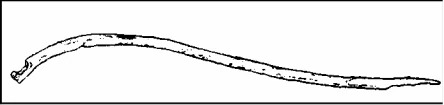 Hh 58). It depicts fiddles and bows in the hands of musicians. In his article “Bogen” in the encyclopedia “Die Musik in Geschichte und Gegenwart,” Werner Bachmann refers to the same source, dating these miniatures in two Mozarabic Apocalypse manuscripts to 970 and slightly later, respectively. Both were produced in Spain, which was then largely under Arab-Islamic rule. Hh 58). It depicts fiddles and bows in the hands of musicians. In his article “Bogen” in the encyclopedia “Die Musik in Geschichte und Gegenwart,” Werner Bachmann refers to the same source, dating these miniatures in two Mozarabic Apocalypse manuscripts to 970 and slightly later, respectively. Both were produced in Spain, which was then largely under Arab-Islamic rule.
While Christian Hannick’s article on “Byzantine Music” in “Die Musik in Geschichte und Gegenwart” contains no reference to bowed instruments, Bachmann’s entry on the bow in the same work reports numerous depictions of bows in Byzantine manuscripts from around the turn of the millennium. Around AD 1025, Byzantium extended from the Caucasus east of the Black Sea to southern Italy, including present-day Turkey, Greece, Bulgaria, and the former Yugoslavia. At the empire’s greatest extent, around AD 565, parts of Spain, stretches of the southern Mediterranean, Corsica, Sardinia, and Arab lands were also wholly or partly under Byzantine rule. Busy Mediterranean shipping and trade may have paved the way for bowed instruments to reach Spain. It is therefore understandable that Bachmann traces the bow’s route into Europe through miniatures in eleventh-century Byzantine manuscripts. According to him, “the bow was introduced into Europe through Spain and Byzantium and applied to the fiddle- and lyre-shaped instruments native to this region, which are already documented there as plucked instruments.” All these bows were strung with horsehair or a string-like material. In this early period, bow shapes and lengths varied considerably and followed no standard. It is striking, however, that most early bows had a strongly convex curve and thus more closely resembled the weapon of the same name.
 The bowed rotte of France, used from the eleventh to the thirteenth century, has its counterpart in the Welsh crwth. As a plucked instrument, the crwth is already mentioned in a sixth-century poem by Venantius Fortunatus, bishop of Poitiers. It spread as far as Brittany, and evidence of its use with a bow dates from the tenth century. The bowed rotte of France, used from the eleventh to the thirteenth century, has its counterpart in the Welsh crwth. As a plucked instrument, the crwth is already mentioned in a sixth-century poem by Venantius Fortunatus, bishop of Poitiers. It spread as far as Brittany, and evidence of its use with a bow dates from the tenth century.
Excavations at Christchurch Place in Dublin uncovered a fragment of an eleventh-century bow. From the break, the stick curves gently, becoming distinctly curved toward the tip, where it has a notch. The horsehair was apparently wound around the stick and tied at this notch (see Fig. 1). If the dating is correct, it documents the spread of bowed instruments as far as Ireland at this time.
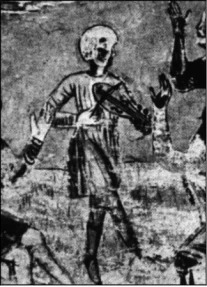
The use of the bow is also documented in eleventh-century Italy. Among the earliest Italian sources is a fresco painted around 1011 in the crypt of S. Urbano alla Caffarello near Rome. It depicts the announcement of Christ’s birth to the shepherds in the fields. One shepherd, apparently in a dancing pose, plays a fiddle held against his chest. The bow shown is very short and also has a handle extension, making the playable hair even shorter (see Fig. 3).
In the tenth and eleventh centuries, many different bow types were tried and, where they proved unsuitable, abandoned or modified. This search for a practical shape suggests that around the turn of the millennium, the bow was still in an early stage and had no established models to draw on.
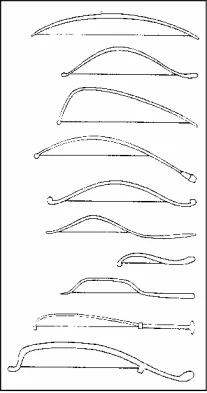
 Several bow shapes continued to coexist into the sixteenth century. As noted above, iconographic research has shown that bows appeared around the turn of the millennium in very different, often extreme forms. There was the large, strongly curved, almost semicircular bow held near the middle of the stick, as well as the flat, barely arched bow whose hair lay almost against the stick. Several bow shapes continued to coexist into the sixteenth century. As noted above, iconographic research has shown that bows appeared around the turn of the millennium in very different, often extreme forms. There was the large, strongly curved, almost semicircular bow held near the middle of the stick, as well as the flat, barely arched bow whose hair lay almost against the stick.
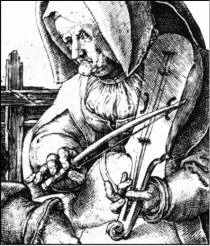
In Lucas van Leyden’s 1524 depiction “Beggar Woman Playing the Fiddle” (see Fig. 4), the hair is tied to a curved stick made from native wood. No head is shown. Instead, the hair forms a loop hooked into a notch above a thickening at the stick’s tip. No frog holding the hair away from the lower part of the stick is visible. On closer inspection, however, the hair is attached directly to the stick by a loop just above the index finger. The bow’s convex curve kept the hair away from the stick while playing.
Alongside the evenly curved round bow, there were bows with a straight stick curved distinctly only at the tip. Another form had a stick extending far beyond the hair at one end. On early examples, this handle section was about as long as the haired section used for playing. The playable hair was therefore very short, allowing only very short bow strokes.
Other depictions, however, show very shallowly curved sticks, often twice as long as the
 instruments they accompany. On these almost straight or partly concave bows, a block or wedge at the grip—often quite tall and now called the frog—separates the hair from the stick. At the other end, however, hair and stick meet. Unlike later bows, the block and stick are often made in one piece or firmly joined. Even on these bows, the full hair length was not yet usable for playing. This problem was solved only when a so-called head was left standing in the wood at the upper end of the stick, holding the hair away from the tip. instruments they accompany. On these almost straight or partly concave bows, a block or wedge at the grip—often quite tall and now called the frog—separates the hair from the stick. At the other end, however, hair and stick meet. Unlike later bows, the block and stick are often made in one piece or firmly joined. Even on these bows, the full hair length was not yet usable for playing. This problem was solved only when a so-called head was left standing in the wood at the upper end of the stick, holding the hair away from the tip.
Even in the Middle Ages, bow sticks were made mainly from wood, which had to combine great strength with elasticity to withstand the required tension. Bamboo sticks can occasionally be identified in thirteenth- and fourteenth-century depictions from regions under Eastern influence. Bamboo is still commonly used today for bows of East Asian folk instruments, but its use for bow making cannot be documented in medieval Europe.
From the thirteenth century onward, sources frequently mention horsehair, whereas in the tenth century, according to al-Farabi, the bow was still strung with “strings or string-like structures,” as noted above. In his book “Die Anfänge des Streichinstrumentenspiels,” Werner Bachmann quotes a Turkish treatise by Ahmedoglu Sükrüllah from around 1400 on bow construction and the amount of horsehair: “And the horsehairs shall be attached to that bow like bowstrings. The number of those horsehairs shall be nine; more than nine is also acceptable, but there shall not be more than forty.” The hair ribbon was therefore generally much thinner than today’s, which contains about 160–180 hairs for a violin bow.
Anke Gerbeth
Image Credits
Fig. 1: Bachmann, Werner: Bogen. In: Finscher, Ludwig (ed.): Die Musik in Geschichte und Gegenwart. Vol. 1. Kassel, 2nd ed., 1994, col. 1638.
Fig. 2: Bachmann, Werner: Die Anfänge des Streichinstrumentenspiels. Leipzig, 1964, appendix, Fig. 28.
Fig. 3: Bachmann, Werner: Bogen. In: Finscher, Ludwig (ed.): Die Musik in Geschichte und Gegenwart. Vol. 1. Kassel, 2nd ed., 1994, col. 1639.
Fig. 4: Geiser, Brigitte: Studien zur Frühgeschichte der Violine. Bern, 1974, appendix, Fig. 44.
|