|
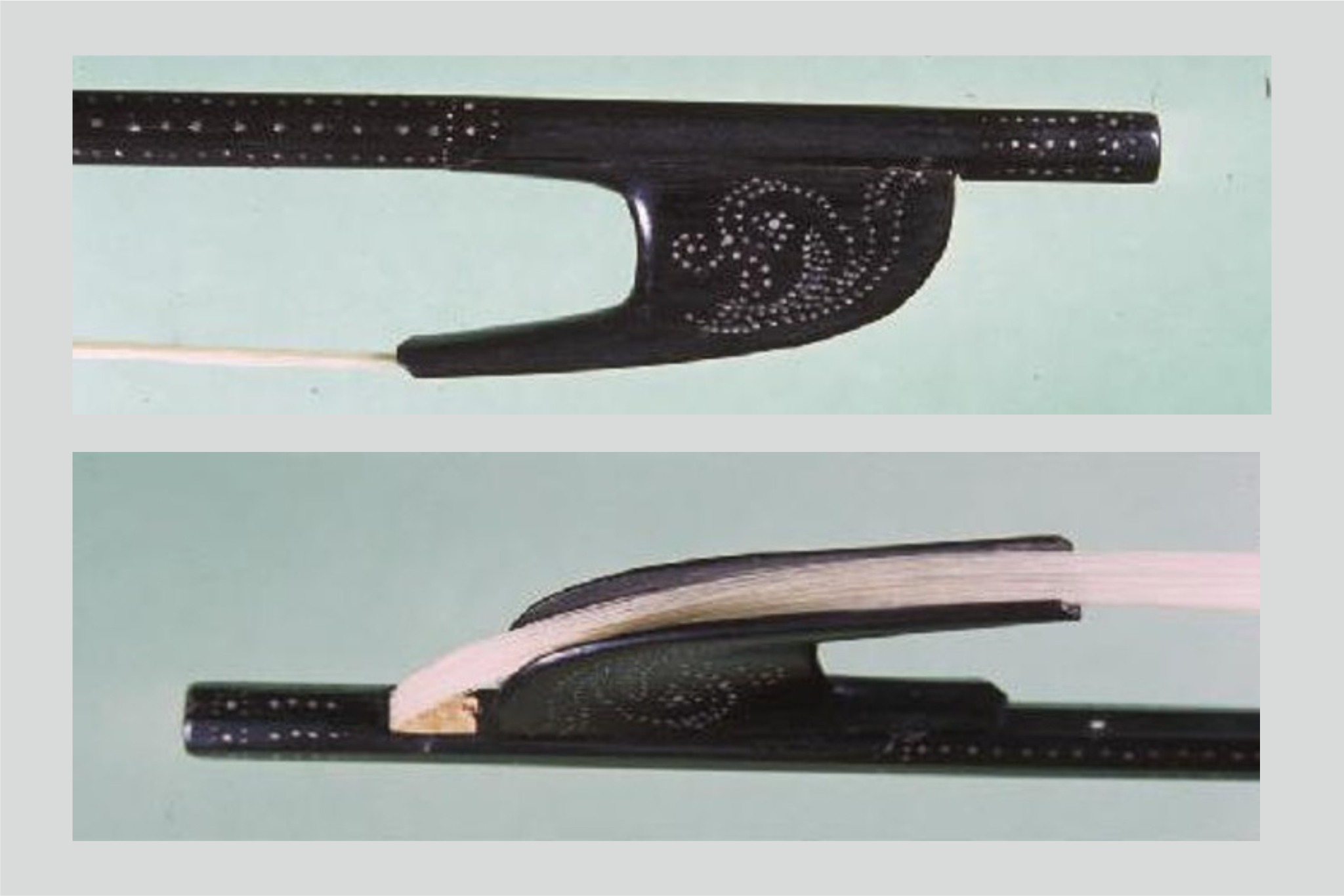
For about 250 years, clip-in frog bows were used exclusively for every type of European bowed string instrument. Around 1500, innovative instrument makers developed late-medieval bow designs into bows whose hair was held away from the stick by a loosely inserted wooden wedge—the so-called clip-in frog. A simple arrangement—a small notch in the stick into which the frog’s front corner fits—allows the tension of the hair to hold the frog securely in place.
The disadvantage of this construction is obvious: hair tension is set when the bow is finished and cannot subsequently be adjusted as it can with a screw mechanism. Some modern bow makers make life easier for players by supplying two frogs of different sizes, to be exchanged according to the humidity. Personally, I am a lazy person and simply slip small pieces of frozen-pizza cardboard under the hair of my clip-in frog bows when playing in churches in midsummer. Seventeenth-century depictions show small patches of leather or pieces of wood inserted to increase hair tension.
These bows were used throughout the sixteenth and seventeenth centuries and much of the eighteenth. The earliest authentic screw mechanisms survive only from around 1750. Even in the 1770s, English musical-instrument dealers’ catalogs offered the less expensive clip-in frog bows alongside bows with mechanisms. We can therefore assume that clip-in frog bows were still used in many cases during the Classical period.
The length and diameter of the stick changed enormously over this period. Initially, viol and violin bows did not differ in construction. Short, stocky sticks, 50–60 cm long, made from tropical hardwoods, with tall frogs and black horsehair, were the standard until the early seventeenth century. A number of these bows can be seen in the Collection of Historic Musical Instruments at Vienna’s Kunsthistorisches Museum. By the late sixteenth century, however, longer and heavier bows were also being made for the viol. Various dense tropical hardwoods were used, including snakewood, “ironwoods,” and pernambuco.
During the seventeenth century, bows grew a few centimeters longer and their sticks became more delicately proportioned. On four surviving German violin bows from the late seventeenth century, the narrowest cross-section just before the head measures less than 4 mm! The heads of many original bows up to Bach’s time are so delicate that the greatest care is needed when cutting the hair mortise. A snakewood violin bow from Biber’s era weighs about 36 g. No preliminary bending of the stick is yet necessary: inserting the frog forces it into a pronounced convex curve, especially toward the delicate head. These bows work beautifully with fewer than 100 hairs. Particularly in fast runs, and with some practice, the violinist can play wonderfully “into the string.”
A fine example from Bach’s time is the bow accompanying a viola d’amore by Caspar Stadler, dated 1714, now in the Germanisches Nationalmuseum in Nuremberg. Small silver pins form an additional floral pattern on the stick and frog. The low head already shows rudimentary features of the shaping common in the late eighteenth century, such as chamfered edges and a small “nose.” The larch violin bow in Vienna’s Kunsthistorisches Museum, with an unusually tall head for its time, also belongs to this period.
Finally, consider the violin bows depicted in Leopold Mozart’s famous violin method of 1756. The already fairly long sticks—see the illustration above, perhaps made of larch because of their substantial cross-section—are clearly depictions of clip-in frog bows. This is most evident in Fig. IV.
From the 1740s onward, screw threads could be machine-produced in larger quantities in France. This is also when the first securely documented bows with screw mechanisms appear. A particularly fine transitional example is the ivory bow displayed at Vienna’s Kunsthistorisches Museum alongside Wenzel Kowansky’s tortoiseshell violin of 1749. Its extremely elegant frog already has a mechanism, connected by a long screw to a slender button. The hair, however, still runs around the underside of the frog as on a clip-in frog bow, then enters a mortise at the top, on the side touching the stick, where it is secured.
Since fitting a mechanism made bow construction more laborious, such bows were—and are—more expensive. Both types therefore coexisted until the late 1770s, before every new bow was eventually fitted with a screw mechanism. Good bows from earlier periods were often retrofitted with mechanisms; original examples survive in Brussels and Munich. This increased the weight at the frog and did not always improve the bow. The sound changed as well, since the hair was no longer attached directly to the stick at both ends.
As a violinist and violist, I have been making and using clip-in frog bows for music written before about 1750 for approximately eight years. After some initial difficulty adjusting, I have learned to play and appreciate the different models. At first, the height of the frog is challenging—on some models the distance between hair and stick is 24 mm—as is the resulting stability when playing in the lower half. Once you become accustomed to the bows’ shortness—my shortest bows have a playable hair length of 45 cm—and play them exclusively and intensively for months, the excessively long pseudo-Baroque bows with screw mechanisms used by most early-music string players seem cumbersome. Their increased weight and different weight distribution produce an entirely different playing feel.
For bows of the sixteenth and early seventeenth centuries, I also use black horsehair, which is somewhat coarser. This provides a more intense and quicker grip, particularly on the violin’s D and G strings. I use plain, unwound gut, as was still common in Italy in Vivaldi’s time; these strings respond incomparably more slowly than silver-wound strings.
In a finely balanced pairing with a correctly reconstructed violin
from around 1600, these bows, in my opinion, give the best results in the music of Marini, Schmelzer, and Uccellini.
Rainer Ullreich, Vienna |