|
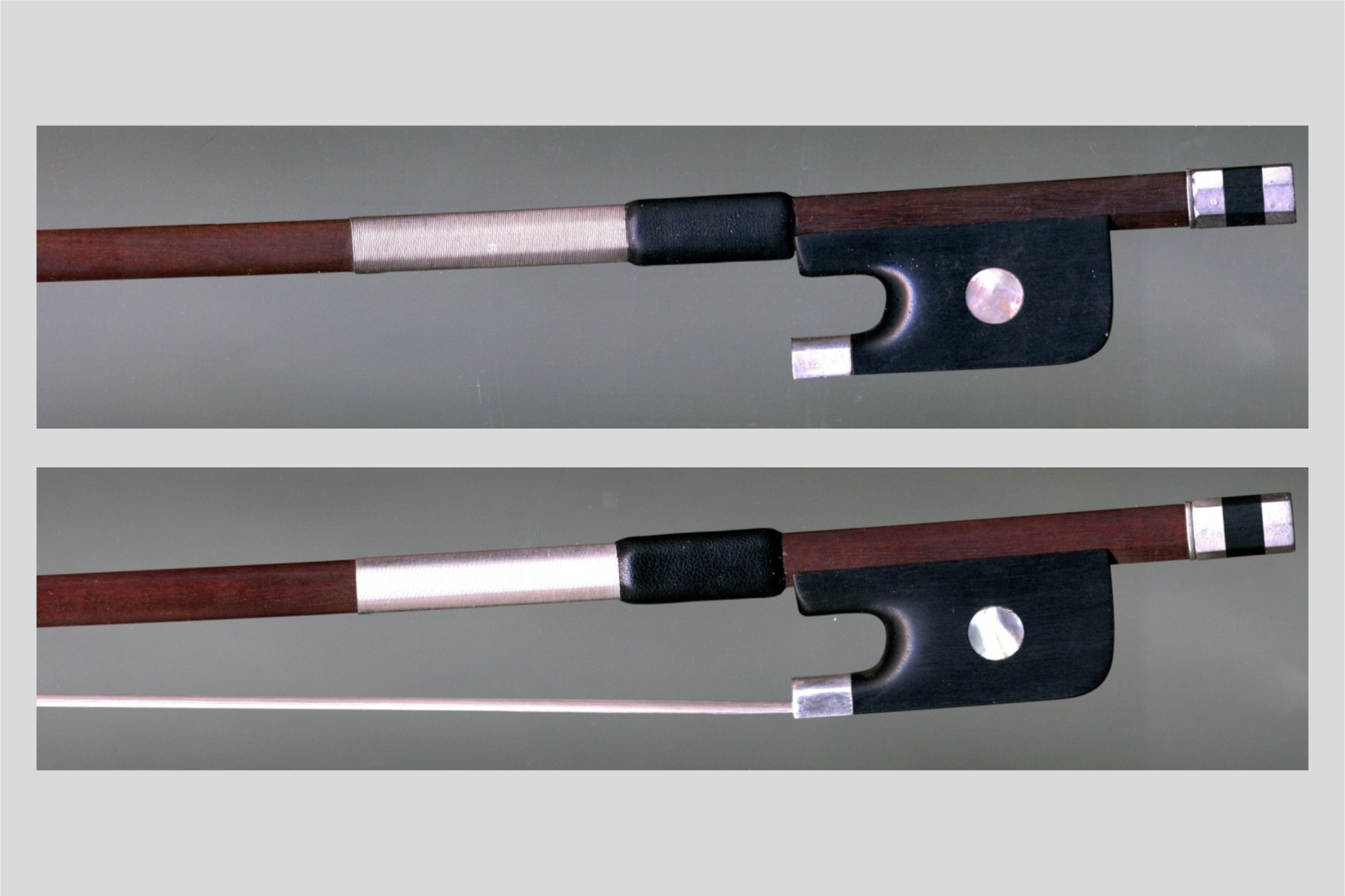
*Very loosely after William Shakespeare What violinist, violist, or cellist has not dreamed of owning a genuine Tourte bow and performing with it? But what makes these masterpieces of bow making so fascinating? Is it simply the prices they fetch at auction, or the widespread legends surrounding this extraordinary maker? Or is it their playing and tonal qualities, audible and palpable in the performances of distinguished artists who have had the good fortune to play with such masterpieces? The Tourte family advanced the development of the bow with extraordinary energy. In the relatively short span of about 40 years, the Baroque bow evolved through the hammer-headed or Cramer bow into the modern form, with its characteristic head and a frog much like the one we know today. Step by careful step, Tourte reconsidered the shortcomings of earlier forms and adapted them to the musical needs of the time. First, the distance between hair and stick at the head was increased considerably, giving rise to the hammer-shaped head. The S-shaped camber of the Baroque bow developed into a V shape (see the diagrams of the camber shapes). After Tourte, continued efforts at “perfection” brought the curve increasingly into line with a mathematical, logarithmic formula. With its very light frog and screw button, often made of ivory, the hammer-headed bow was markedly tip-heavy. This led to the development of the modern head and the addition of a ferrule, heel plate, and slide to the frog. Two metal rings added about 2 grams to the button. The bows now weighed around 56 g, and their balance point was improved. Yet analysis of surviving originals reveals, contrary to expectations, that their camber and stiffness differ markedly from those of all modern bows. V-shaped camber underlies every example, even though “experts” have altered many of them. Measurements of the sticks’ flexibility might initially suggest that sustained tone production would be impossible. Nevertheless, these bows seem almost to adhere to the string, drawing the sound out of the instrument. The reason is precisely this combination of a flexible stick and the camber illustrated here. It allows the head and frog to yield so that sound can be produced through pulling and pushing movements with almost no pressure. Low weight is no longer perceived as a drawback: the sound is large, richly varied, and responsive to modulation. The bow responds spontaneously to the musician’s smallest impulses. It is forgiving, but it also resists when the player tries to work against it. “It simply plays itself” is a frequently heard comment. Bow 1 (top): Baroque violin bow, attributed with very high probability to the Stradivari workshop, early 18th century Every Bogenmachermeister hopes to hear such a judgment of their own work and therefore tries to understand the reasons behind these qualities. “Surely the explanation cannot lie in that irregular camber.” “This flexible stick could be improved, too.” Many bow makers reason along these lines and thereby miss their chance to uncover the old bows’ “secrets.” Their aim has often been to correct “obvious” faults or departures from the norm. The result is frequently a beautiful copy with an exquisitely carved head, an elegant frog, and a precisely made button. Only the stick fails to follow the original. The sticks are stiff and cambered with mathematical perfection, producing bows that function well technically—with one small drawback: they produce a narrow, sharp sound and, in extreme cases, can stifle the instrument. Why? Hair tension increases, reducing the area of contact with the string. Vertical pressure is needed to engage the string. This encourages a desire for heavier bows to do that work for the player. Greater weight, in turn, means greater stick stiffness and a further increase in hair tension. Added to this is many bow makers’ fear of musicians calling their bows too soft. Yet this statement rests on a longstanding misunderstanding between makers and players. When bow makers hear “hard” or “soft,” “stiff” or “flexible,” they first think of the wood’s physical stiffness. But when a player draws a bow across the string without adding an impulse, a departure from an ideal camber—whatever its exact form—or an error in the stick’s shaping can cause the stick to move vertically on its own. It strikes the string and is perceived as “soft,” regardless of its physical stiffness. The player is also startled and tries to compensate. This effect occurs independently of the bow’s stiffness. Makers who supply mainly dealers nevertheless often hear that their bows are too “soft,” without being told the cause and, more seriously, without the diagnosis being correct. Their next delivery to that dealer is therefore even stiffer in physical terms, while the actual faults remain unidentified and uncorrected. The search for the reasons behind the special qualities of old bows thus leads us in the opposite direction. We need to examine the stick’s stiffness, shaping, and camber. What, then, must a bow maker do to build on the achievements of the old French makers? How can an old bow be copied so that the copy not only looks like the original, but also feels, plays, and sounds like it? Wood selection comes first. Pernambuco, the wood used for most high-quality modern bows for stringed instruments, occurs in different morphotypes, only a few of which are used in bow making. Growing location, soil, climate, and the position of the sawn stick within the tree all produce variations in physical properties such as stiffness (modulus of elasticity, or E-modulus) and density. For a copy, these properties must match in the original and the selected blank. Values range from 16 to 38 N/mm² for the modulus of elasticity and from 0.80 to 1.40 g/cm³ for density, yielding around 1,500 relevant combinations. The Vienna workshop of Bogenmachermeister Thomas M. Gerbeth has developed a measurement method for calculating these physical values for both a finished original bow and the roughly sawn blank intended for its copy. A computer program was developed for this purpose with Günter Teuschler of Erlangen, Germany, Thomas Gerbeth’s father-in-law. It allows the data to be projected at almost any stage of the work. Stick dimensions and stiffness profiles are related to one another and interpolated from the raw blank to the finished dimensions, or in the opposite direction. Combined with the computer program, this measurement method allows the stiffness profile of a stick to be monitored precisely throughout the making process. These technical aids serve only to check the work and to select and sort material. It remains the maker’s craft to achieve the recommended values in the wood, using traditional techniques with planes, files, and carving knives, often much as the French makers of the 19th century did. Other workshops often reject sticks only once work is well advanced because they fail to meet expectations formed through assessment by feel alone. Thomas Gerbeth, by contrast, knows from the outset what the finished bow will be like: its weight, balance point, and playing characteristics. This allows him to make optimal use of the roughly 6,000 blanks he holds in stock of this unfortunately increasingly scarce wood. The inventory is documented in the workshop’s material ledger, maintained continuously since pernambuco first came under species protection in 2007. For a copy of a Tourte bow, for example, the process is as follows: Once all the original bow’s measurements have been recorded—total weight, individual component weights, lengths, heights, thicknesses, balance point, and so on—the wood’s modulus of elasticity and density are calculated. Thomas M. Gerbeth then searches his pernambuco stock for a roughly sawn blank with matching physical properties. If he finds the ideal blank and reproduces the original dimensions precisely, the finished copy will have the same weight, almost the same stiffness profile, and the same balance point as the original. Bow 3 (top): violin bow, F. X. Tourte, France, around 1820, Camber is also enormously important to playing and tonal qualities. Only a precise copy of the camber can make the copy comparable to the original. Sometimes small inconsistencies in the original can even be compensated for through adjustments to the copy’s camber. Copying old bows has limits, however. Thomas Gerbeth considers the original owner’s consent essential in every case. Since the owner will generally have paid far more for the original than a copy would cost, they also have the right to decide whether a “twin” should exist. This avoids the very uncomfortable prospect of conflict between our workshop and fellow instrument makers or specialist dealers who rely on selling old bows and would understandably object to a customer borrowing an expensive bow on trial, having it copied, and then returning the original. Even with ever more refined measurement and working methods, some small difference between original and copy must be expected. If the artist can describe those differences, however, Bogenmachermeister Gerbeth can make lasting improvements through fine adjustments to the camber. Since artists generally know their own instrument, original bow, and desired qualities best, these adjustments are made by the Bogenmachermeister in a joint session with the player. When, then, does copying an old bow really make sense? Musicians may have several reasons for wanting a copy. A colleague or teacher might own a bow they would love to play but that is not for sale. They may wish to preserve their own original, consider travel too risky, or want a spare with almost the same qualities as their familiar, much-loved first bow. Another possibility is that the original has irreparable damage, but the player does not want to lose its familiar and cherished qualities. In that case, whether a copy can be made depends on the severity of the damage—that is, whether all the original’s properties can still be measured in detail. An artist commissioning a copy should be clear about whether they truly want all the original bow’s characteristics. If changes are desired, an early discussion with the Bogenmachermeister can establish which are feasible and useful during the making process, and how they will affect the finished bow. An exact copy always includes any “faults” the original may have. Continually improving techniques for copying bows open up possibilities that musicians could scarcely have imagined before. At a time when prices for old French bows have risen to enormous sums, and young musicians in particular can rarely afford them without a patron’s support, they need not forgo those much-loved tonal and playing qualities. Anke and Thomas M. Gerbeth |
Articles
To Copy or Not to Copy
Working with the Heritage of Bow Making